Quinceañera invitation wording: examples in English and Spanish
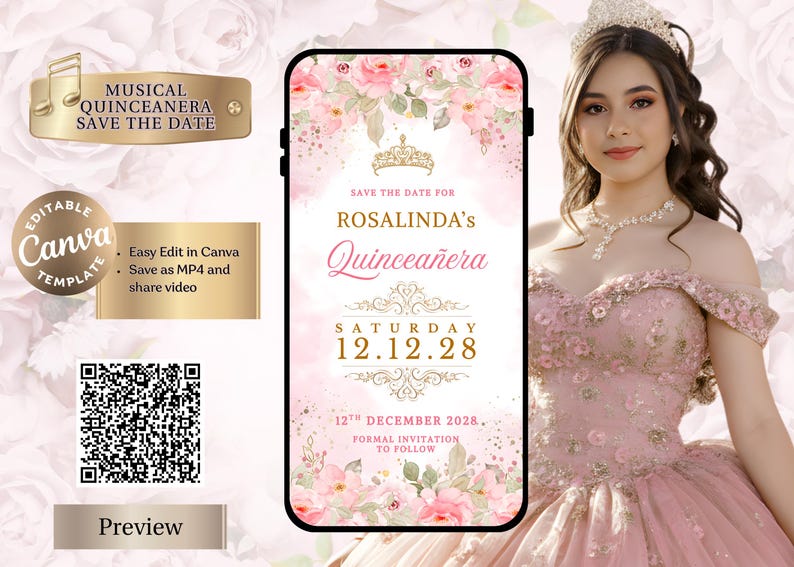
The design catches the eye, but the words are what guests use: who is hosting, where to be, when to arrive and how to reply. Get the wording right and most guest questions are answered before anyone calls you.
Below is the order most quinceañera invitations follow, then ready-to-adapt examples in English, Spanish and both languages together. Change the names, dates and tone to fit your family.
What goes on a quinceañera invitation, in order
- Hosts. Traditionally the parents, sometimes with the padrinos or grandparents. If a single parent, both parents and step-parents, or the quinceañera herself is hosting, the invitation can say so.
- The invitation line. A sentence that asks the guest to celebrate with you.
- Her name. The biggest line on the card. Use the full name she wants to be known by, often including a second last name.
- The occasion. "Her quinceañera," "her fifteenth birthday" or "mis XV años."
- The Mass or blessing. Date, time, church name and full address, if there is a religious ceremony.
- The reception. Time and full address of the venue. If it follows straight after Mass, say "Reception to follow at...".
- RSVP. A reply-by date and how to reply: a website link, a QR code or a phone number.
- Optional extras. Dress code, padrinos, the court of honor, gift preferences, and whether children are invited.
You do not need every extra on the main card. A video invitation or printed card works best with the essentials only, and an invitation website can hold the rest.
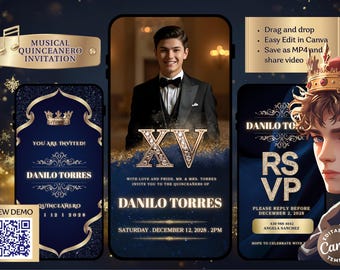
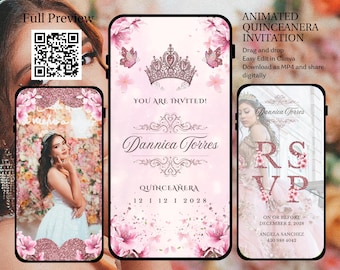
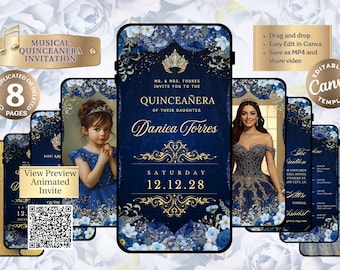
Formal English wording
Formal wording suits a church Mass followed by an evening reception.
Mr. and Mrs. Carlos and Elena Ramírez
request the honor of your presence
at the Thanksgiving Mass celebrating the fifteenth birthday of their daughterSofía Isabel Ramírez Torres
Saturday, the thirteenth of March
at two o'clock in the afternoon
St. Joseph Catholic Church, 1200 Main Street, San Antonio, TexasReception to follow at six o'clock in the evening
The Grand Hall, 455 River RoadKindly reply by February 13
Small details that keep it formal: spell out the date and time, write "request the honor of your presence" for a church ceremony and "request the pleasure of your company" for the reception only, and avoid abbreviations.
Modern English wording
Modern wording is warmer and shorter, and it often speaks in her voice.
Join us as we celebrate
Sofía's QuinceañeraSaturday, March 13
Mass at 2 PM, St. Joseph Catholic Church
Party at 6 PM, The Grand HallHosted by her parents, Carlos and Elena Ramírez
RSVP by February 13 at the link below
Spanish wording
Spanish invitations often open with a short dedication or a line of thanks to God and the family. Write your own words; it feels more personal than a borrowed verse, and you avoid copying someone else's poem.
Formal:
Con la bendición de Dios y el cariño de nuestra familia,
Carlos Ramírez y Elena Torres de Ramírez
tienen el honor de invitarle a la Misa de Acción de Gracias
por los XV años de su hijaSofía Isabel Ramírez Torres
Sábado 13 de marzo, 2:00 p.m.
Parroquia San José, 1200 Main Street, San Antonio, TexasY a la recepción que se ofrecerá a las 6:00 p.m.
en The Grand Hall, 455 River RoadFavor de confirmar su asistencia antes del 13 de febrero
With padrinos:
Mis padres, Carlos y Elena,
y mis padrinos, Jorge y Lupita Hernández,
tenemos el gusto de invitarle a celebrar mis XV años
Modern, in her voice:
¡Llegó el día que tanto soñé!
Te invito a celebrar mis XV años
Sábado 13 de marzo, 6:00 p.m., The Grand Hall
Confirma tu asistencia antes del 13 de febrero
A note on usted and tú: "invitarle" and "su asistencia" are formal and suit invitations from the parents to the whole family. "Te invito" and "confirma" are friendly and suit an invitation in her voice or one sent mostly to friends.
Bilingual wording
Many families send one invitation that works for grandparents in Mexico and classmates in the US. Two layouts work well:
- Side by side or stacked. The full Spanish text, then the full English text. Clear, but it takes space, so it suits printed cards and invitation websites more than a short video.
- Mixed. One language for the warm parts, both for the practical details. For example, "Mis XV Años" as the title, the invitation line in Spanish, then the date, address and RSVP in English and Spanish.
Mis XV Años
Sofía Isabel Ramírez Torres
Sábado 13 de marzo / Saturday, March 13
Misa / Mass: 2:00 p.m., Parroquia San José
Recepción / Reception: 6:00 p.m., The Grand Hall
Confirmar / RSVP: antes del 13 de febrero / by February 13
Keep the date, times and addresses identical in both languages, and read them twice. A mismatch is the most common bilingual mistake.
Optional lines, and how to word them
Dress code. "Formal attire" or "Etiqueta rigurosa" for a black-tie evening; "Cocktail attire" or "Vestimenta formal" for most receptions. Some families ask guests to avoid the quinceañera's dress color, which you can phrase kindly: "We kindly ask guests to reserve the color pink for the quinceañera."
Adults only. Address the envelope or message to the exact people invited, and add a gentle line such as "We respectfully request an adults-only reception" or "Agradecemos su comprensión: evento solo para adultos."
Gifts. Many people feel a registry on the main card is too direct. Put gift details on the invitation website instead. If your family follows the tradition of a lluvia de sobres (envelopes with a cash gift), a short line works: "Lluvia de sobres" or "Your presence is our greatest gift; if you wish to give something, an envelope will be welcome."
Padrinos and court of honor. Thank them by name on the website or a printed card; the video can keep to the hosts and her name.
Where each piece of wording goes
The cleanest plan is to keep each format focused:
- Save the date: her name, the date, the city, and "invitation to follow."
- Video invitation: the essentials, short enough to read in the time each scene is on screen.
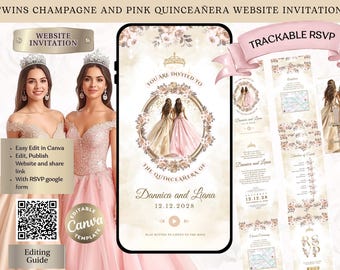
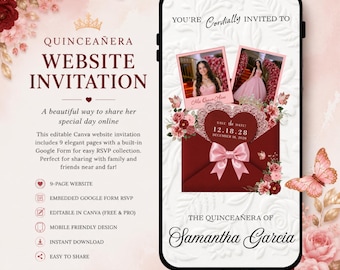
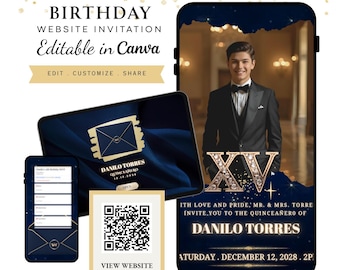
- Invitation website: everything, including maps, hotels, the full schedule, padrinos and the RSVP form.
- Printed card: the formal wording for grandparents and padrinos, with a QR code to the website.
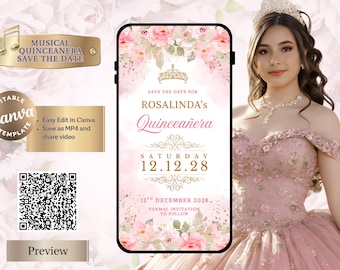
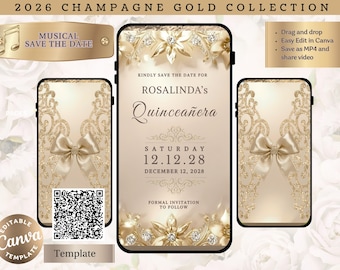
If you are still deciding on formats, our guide to digital or printed quinceañera invitations compares them, and the party planner works out when to send each one from her quince date. You can browse every quinceañera video invitation we make, all fully editable in Canva, in English, Spanish or both.
A quick proofreading checklist
Before you send or print anything:
- Her name is spelled exactly as she wants it, accents included (Sofía, not Sofia, if that is her spelling).
- The day of the week matches the date.
- Times say a.m. or p.m. and the addresses include the city.
- The RSVP date is about three to four weeks before the party, so you have time to give the venue a final count.
- Someone who did not write it has read it aloud once.
Frequently asked questions
Who is listed as the host on a quinceañera invitation?
Usually the parents. You can add padrinos or grandparents who are helping to host, or write it in the quinceañera's own voice for a more modern feel. There is no single correct choice; pick the one that reflects who is actually hosting.
Should a quinceañera invitation be in English or Spanish?
Write it in the language your guests read most comfortably. Many families choose a bilingual invitation, with the title and greeting in Spanish and the practical details in both languages.
How far in advance should quinceañera invitations be sent?
Most families send invitations six to eight weeks before the party, after a save the date six to eight months ahead. The quinceañera planning timeline lays out each step.
Can I change the wording on a template?
Yes. Every word in our Canva templates can be edited, so you can use any of the examples above or write your own in English, Spanish or both.